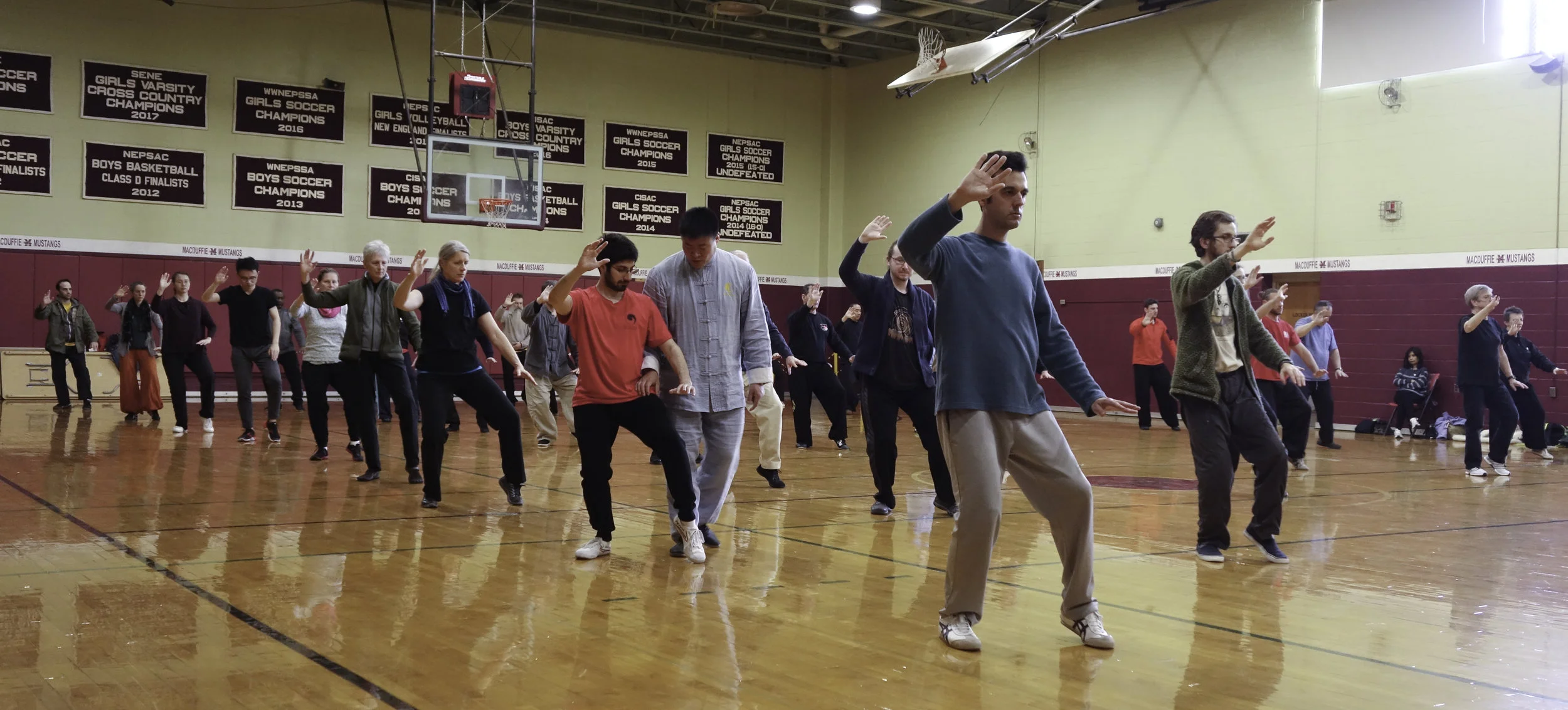
Bai He Liang Chi

Bai He Liang Chi, White Crane Spreads Its Wings, is the 7th posture in Lao Jia Yi Lu and is repeated three times. Each Bai He Liang Chi is followed by Xie Xing, Diagonal Posture.

At the completion of this form the left hand faces down and is connected with the left knee, energetically. It is connected to the earth and is heavy. The right hand faces upwards and is light and connected to heaven. Even though the right hand faces upward the elbow remains dropped to retain peng. The back forms an arch leading from the lowered left hand to the raised right hand.

The two hands, as they move within the execution of the form, follow circular paths in opposite directions in front of the body with the upper protecting the head and the lower the body.  As one goes through the transitional twining of this position weight shifts take place with turning of the body, driven by the waist energy. In the final section of the posture the body relaxes and sinks down sending the energy to the dantian.

One day, while kayaking, this blogger/taiji student saw a blue heron take off. As I watched the bird propel itself with its wings I realized that the power for the flying and flapping of wings came from the middle of the bird's back and that the bird's movement was perfectly coordinated. Since then I imagine myself as the blue heron, which I expect moves similar to a white crane. I now move into this form sensing that the power of the movement comes from the center of the back just as I saw with the blue heron.

February 27, 2015

Connections

3.16 tai eli 3.jpg

The right shoulder connects with the left hip; right elbow with left knee; the right wrist with left ankle. And naturally, left shoulder with right hip, and so forth.

The right shoulder connects with the right hip; right elbow with right knee; right wrist with right ankle. Likewise the left shoulder connects with the left hip, etc.

As one trains feel these connections within the body. Feel the connections in the postures especially as the body settles. These settling postures include, for example, Lan Za Yi (Lazily Tying One's Coat), Dan Bian (Single Whip), and Xie Xing (Diagonal Posture). Also feel these connections throughout the form while moving and transitioning.

February 27, 2015

Qi Shi, Opening Movement, Must Be Done Well

Qi Shi is the opening movement. When the first form is correct then the complete form will be done well.

Grandmaster Chen Zhenglei writes in Chenjiagou Chen Style Tai Ji Quan that once in the standing posture the mind concentrates, clears, and calms. The energy or qi drops and the breath is natural.

Master Wang describes the form during training. To complete this movement one must feel the energy as the body relaxes. The energy sinks even before moving. When the arms feel heavy they start to raise up and to extend. The chest is slightly concave and the back is slightly out. Extend and feel the back open. The arms stretch far forward, but not too far. In extending the arms the shoulder joint opens. When the arms reach shoulder level the arms start to lower and to push the air until they reach hip level. The hips relax. The hip joint relaxes. The mingmen is out a little and protects the organs.

Before turning to the left turn slightly to the right. The left arm is peng and extends and connects all of the joints so there is no blockage. When the left arm is peng it is easier for the right side to have peng. Wen one side is missing peng it is easy for the other side to be missing peng. There should be peng in 360 degrees. Peng on the outside means that there is connection on the inside. The elbow, the hand and all parts of the body connect to each other and to the dantian. When there is connection the body is filled with energy.

February 1, 2016

High Level Taiji: Looseness, Softness, Sound of a Dropping Foot

In the past a person's taiji skill level was judged by the softness and looseness of the person's taiji form. Those with a soft and loose form were considered to have a high level of kung fu, of taiji practice.

The quality of a person's taiji could be determined by the sound made when the person dropped their foot during the form.  The sound of the dropping foot is solid and can be felt along the floor or the ground. One can hear the power that is within the leg, within the body, and is not being thrown away. One can hear the connection. When the body is not balanced the sound of the dropping foot lacks connection.

March 2016

Peng

Peng is the open, rounded, arched structure throuhgout the body that results in an equalized pressure to all sides of each part of the body. When peng is attained the feeling in the body is as if the whole body were a very large ball. Think of the body as an inflated ball with equal pressure going out from all sides and coming in from all sides. Peng gives great strength to the body, making it, in a way, invincible. It is difficult to push in on a basketball, or on a person whose body is peng. Roundness deflects incoming forces. When a force hits an inflated ball the force bounces away. The force spins the ball, and the ball remains stable. This roundness, or openness is held, not with force, power or strength. Peng is held with looseness and with softness from which comes agility, flexibility, and strength.

When peng one can easily change direction. Peng in one direction leads to peng in the next direction. With peng one feels connection to all parts of the body and within all parts of the body. Peng does not reach too far, nor does it collapse.

Peng is achieved with the loosening of all of the joints. The feeling of looseness is found with the proper peng. Proper posture with peng results in the development of chi.

February 8, 2015

The Finger Stomach, Tiger's Mouth, and Roof Tiles

The middle joint of the finger is the "finger stomach". In taiji practice this "stomach" is extended, is peng, is stretched out and strong.

The stretching of the finger stomach is coincidental with formation of the "tiger's mouth". The "tiger's mouth" is the part of the hand that is found between the thumb and the first finger as they stretch, open and close simultaneously to create a circular rounded peng that can be used to grab or hold. The "tiger's mouth" is open and closed at once. One should be able to feel the energy in this space.

The small finger and the thumb reach toward each other, and away at the same time--open and closed at once. The hand in total is shaped like a "roof tile" (look for images of Chinese roof tiles that are flatly rounded in form).

September 30, 2014